Keep decisions explainable
Deterministic, centrally configured rules choose the route. Optional local Ollama extraction returns structured fields that are validated, with a fallback path when the model is unavailable or its response is invalid.
A self-initiated local prototype for turning a service-business enquiry into a validated lead, an explainable qualification decision, and follow-up work an operator can review.
A lead can be lost between intake, qualification, a CRM entry, a first response, and later follow-up. When all those responsibilities sit in one long workflow, it can be hard to see what happened or safely recover from a partial failure. This prototype separates those jobs into five n8n workflows around a versioned lead contract and a local PostgreSQL database.
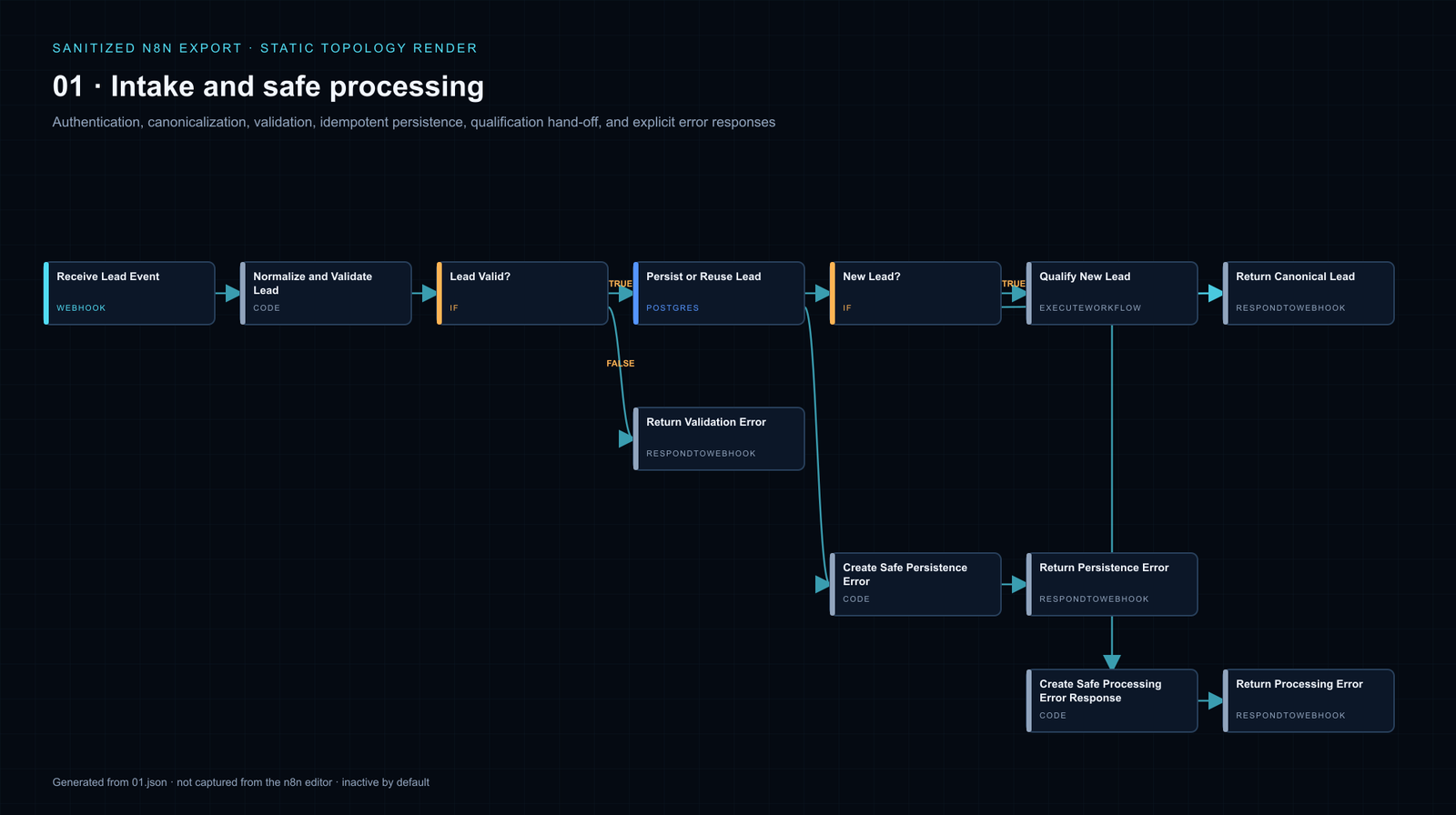
An authenticated event is normalized and checked before storage or downstream actions. The workflow records what happened so duplicate events and partial outcomes can be reviewed.
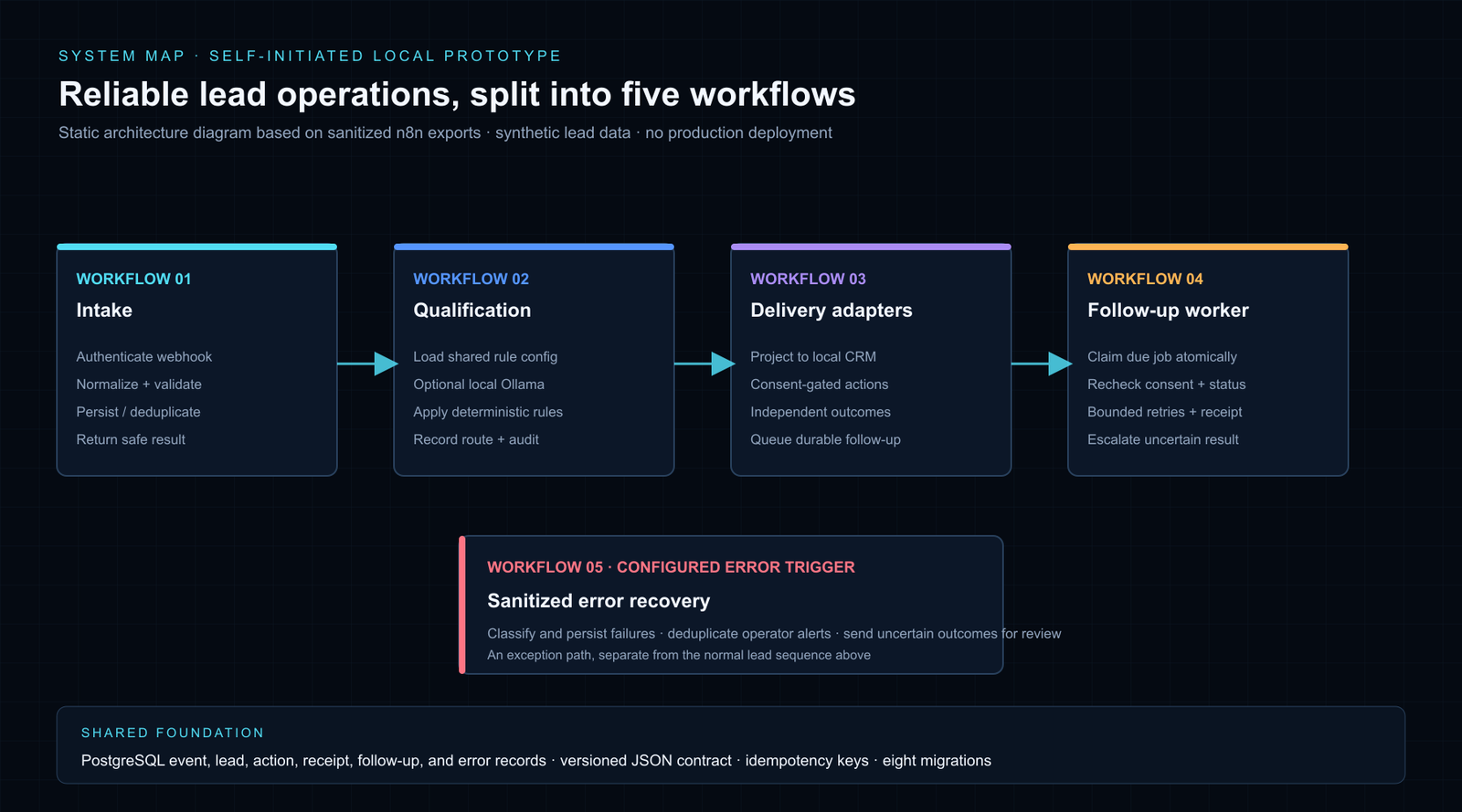
I designed and built the workflow boundaries, JSON contract, database schema and migrations, local adapters, verification fixtures, and documentation.
Deterministic, centrally configured rules choose the route. Optional local Ollama extraction returns structured fields that are validated, with a fallback path when the model is unavailable or its response is invalid.
PostgreSQL event and action keys support the tested duplicate-replay paths and create a record of what happened.
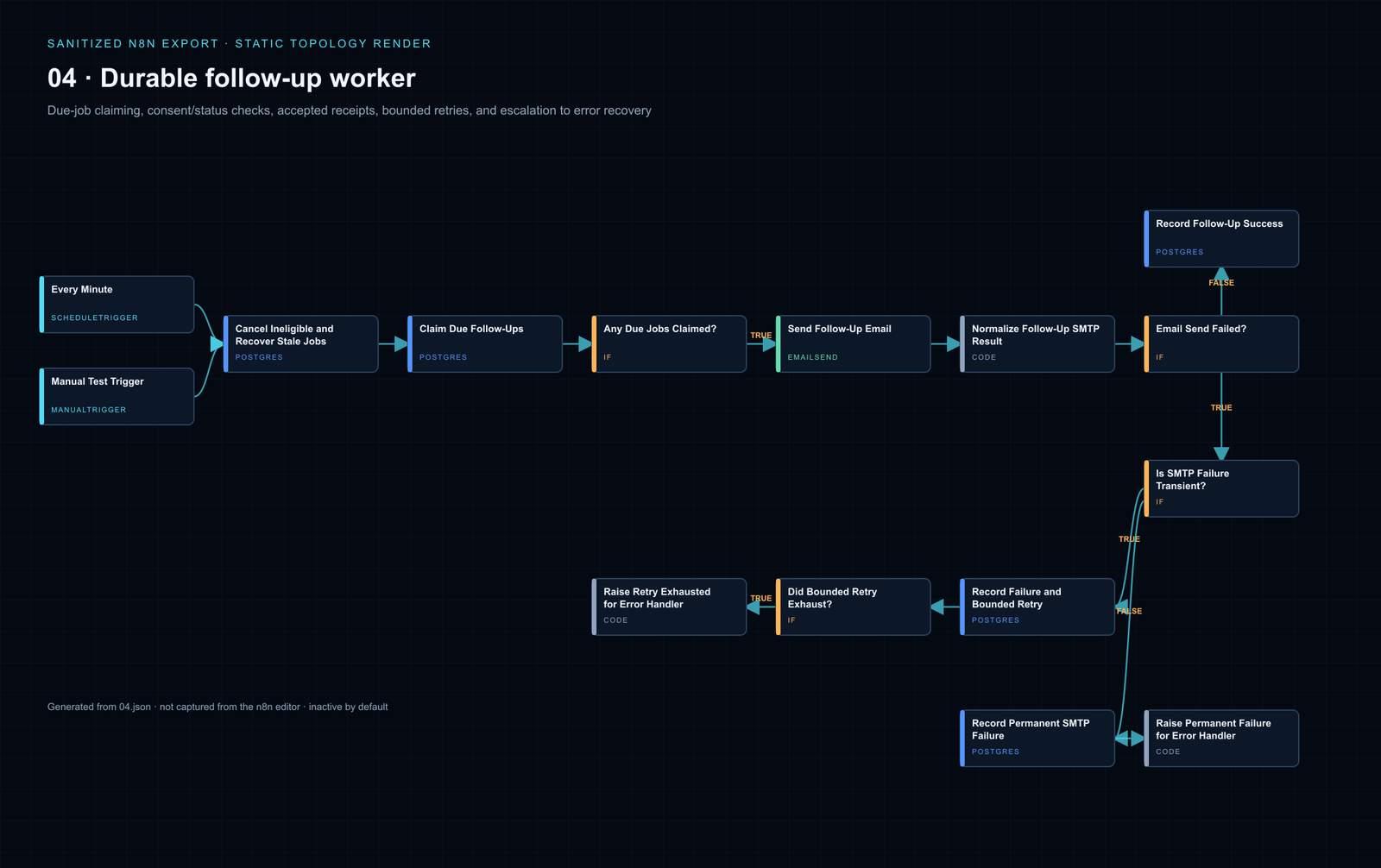
Delivery actions track separate outcomes and bounded retries. A missing or ambiguous receipt goes to review rather than triggering a blind resend that could duplicate a message.
The prototype includes five separated n8n workflows, eight PostgreSQL migrations, configurable rules, fixture data, sanitized exports, setup notes, an operations runbook, and a repeatable demo script.
These static topologies show the node names and connections in the sanitized workflow exports. They are diagrams, not captured workflow-editor screens.
Verification used n8n 2.8.4, local PostgreSQL, local Ollama, Mailpit, and loopback provider mocks. No paid provider calls were used in the clean-package tests.
Two clean passes of a 32-scenario matrix (32 cases per pass), plus a separate fresh-instance import, migration, and functional smoke.
Eighteen focused SMTP/Telegram result-classification checks and seven operator-receipt guard checks.
Duplicate replay left downstream SMTP, Telegram, and model counters unchanged. Invalid input returned HTTP 422; missing authentication returned HTTP 403.
Concurrent follow-up workers claimed one job and produced one accepted local receipt. Exhausted retries reached error recovery. All eight migrations applied to an empty test database.
All five exported workflows imported inactive with their subworkflow and error references intact.
Mailpit acceptance does not prove an email reached an inbox. A Telegram mock receipt is not a real Telegram send. A model mock checks integration plumbing, not model quality.
This image renders the recorded Phase 11 test evidence. It is explicitly an evidence report, not a screenshot of the n8n execution screen.
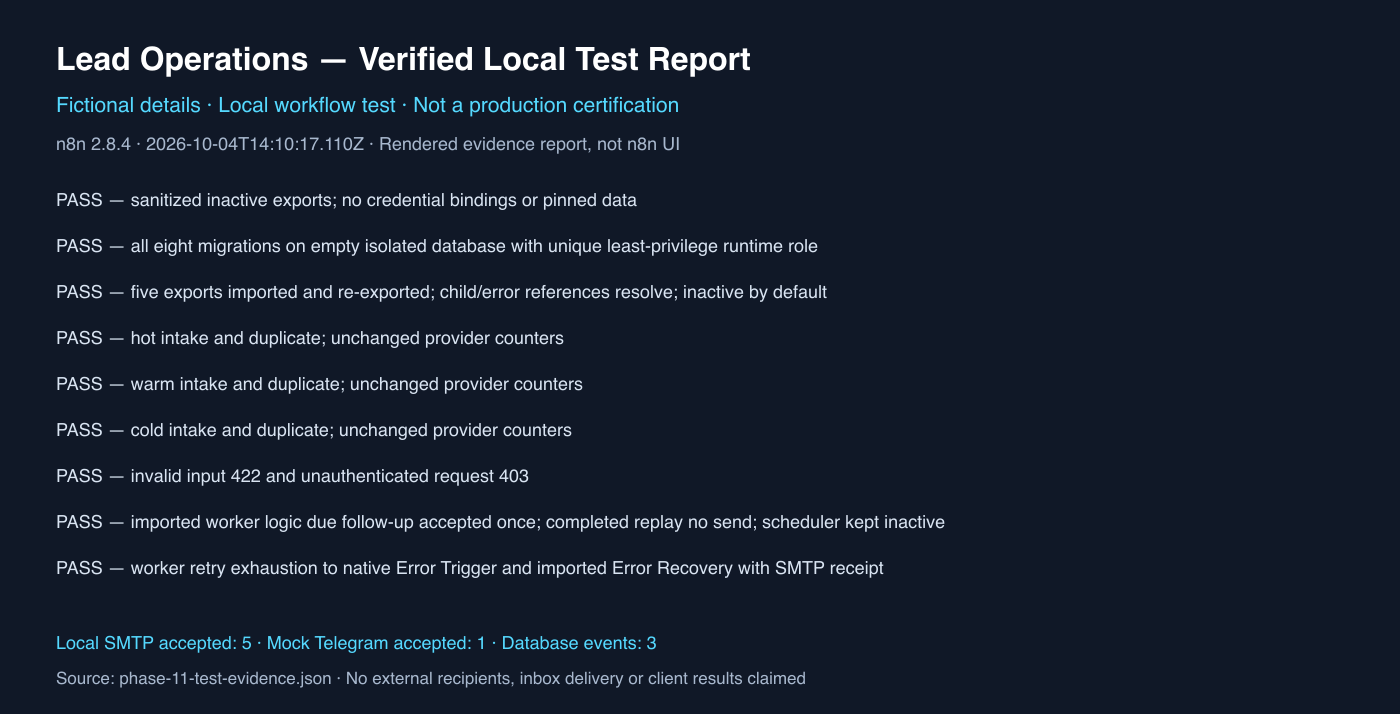
The test data is synthetic. The provider paths used local Mailpit SMTP and loopback mocks. The original workflows remain inactive by default.
No real customer message, booking, external CRM integration, provider delivery, public deployment, uptime, or production model quality was tested.
This is self-initiated prototype work with synthetic leads—not client work, production software, evidence of revenue, conversion improvement, or other business results.
A real setup would need a defined intake source, contact consent, routing and escalation, real provider accounts and credentials, retention, security, backup and restore, costs, and operational ownership.
Provider acceptance checks would need to run in a client-approved environment. The local mock checks do not establish that external services are connected or ready for use.
DM “CALLS” on Instagram with your trade and how you currently handle new enquiries.